Candidates near passing but still missing too many SAFE MLO questions
NMLS Score 60 to 74: Recovery Plan Before Your Retake
A practical recovery plan for candidates scoring between 60 and 74 on NMLS SAFE MLO practice or exam attempts, with fixes by mistake type.
By SafeMLO Coach Editorial Team. Reviewed against official NMLS, CSBS, CFPB, and Prometric materials. Updated June 26, 2026.
Direct answer
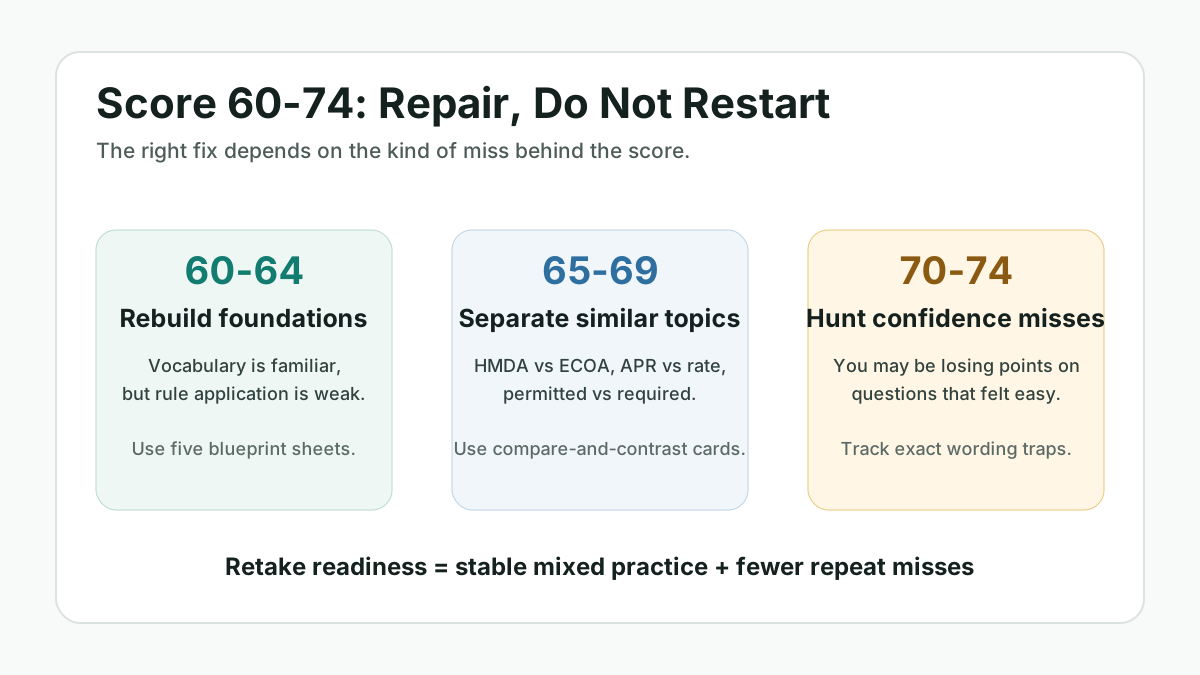
A 60-74 score usually means you need repair, not a total restart. Low 60s candidates should rebuild foundations, high 60s candidates should separate similar topics, and low 70s candidates should hunt the high-confidence misses that quietly block a passing score.
A score in the 60 to 74 range usually means you are not starting from zero. You probably recognize many terms, and some explanations may make sense after you read them. The problem is that recognition is not yet turning into reliable choices under test wording.
This plan is for candidates who are close enough that random studying starts to feel maddening. The fix is not simply more questions. The fix is identifying which kind of near-pass problem you have and repairing that pattern directly.
Decision guide
| Situation | Best move | Why it matters |
|---|---|---|
| Score is 60-64 | Rebuild the five blueprint sheets before more full mocks | This range often means you recognize the vocabulary but cannot reliably apply the rule to facts. |
| Score is 65-69 | Compare confusing pairs side by side | Mid-60s misses often come from mixing up similar laws, timing rules, or loan terms. |
| Score is 70-74 | Review high-confidence misses first | Near-pass candidates often lose the exam on questions they did not think needed review. |
If your score is 60-64: rebuild foundations first
A low-60s score often means you recognize vocabulary but cannot reliably apply rules to scenarios. Spend less time on full mocks and more time on blueprint buckets.
Build five sheets: federal laws, UST, general mortgage knowledge, origination activities, and ethics. Each sheet should list rules, triggers, and common wrong-answer patterns. Keep the sheets short enough that you will actually review them.
Do short focused sets and explain misses out loud. If you cannot explain why the correct answer fits, the review is not finished.
If your score is 65-69: fix confusion between similar topics
Mid-to-high 60s candidates often confuse similar concepts: HMDA versus ECOA, APR versus interest rate, permitted versus required, changed circumstance versus general fee change, or ethical concern versus legal duty.
Create compare-and-contrast cards. Put the two confused topics on the same page and write what triggers each one. This matters because the exam often rewards the candidate who notices that a good-sounding answer belongs to the wrong rule.
Practice mixed sets after each contrast review. You need to recognize the topic without a label, because the real test will not tell you which chapter you are in.
If your score is 70-74: hunt high-confidence misses
Near-passing candidates often lose the exam on questions they thought they knew. These are high-confidence misses, and they deserve separate tracking.
After every practice set, mark questions you felt sure about but missed. Write the exact phrase that changed the answer: before, after, may, must, prohibited, required, applicant, borrower, settlement service, or advertisement.
Your goal is not to become more nervous. It is to become more precise. Confidence is useful only when it is attached to the actual wording.
How to know you are ready to retake
Do not rely on one good practice score. Look for stable improvement across mixed sets and fewer repeat mistakes in your missed-question log.
You should be able to explain wrong answers, not just identify correct ones. The explanation skill is what protects you when the wording changes.
Before scheduling or retaking, confirm current retake and waiting-period rules with NMLS. Your study calendar should respect official timing.
Common mistakes to avoid
- Treating a 72 practice score as automatic readiness: Look for consistency across mixed sets, not one good day. A shaky 72 can still hide repeated weak spots.
- Only drilling the topic label you already know: Use mixed practice to prove you can identify the topic without a label.
- Ignoring second-best answer choices: Write why the second-best answer is too broad, too early, too late, unsupported by the facts, or outside the MLO role.
Study checklist
- Separate low-60s, high-60s, and low-70s problems.
- Use compare-and-contrast cards for similar topics.
- Track high-confidence misses separately.
- Require explanations for wrong answers.
- Confirm retake timing with official NMLS guidance.
Related practice topics
Is a 70 to 74 practice score close enough for the NMLS exam?
It is close, but not comfortable if the score is unstable. You want consistent mixed-set performance and fewer high-confidence misses before relying on that range.
What is the fastest way to improve from the 60s on NMLS practice tests?
Stop taking unreviewed full tests. Tag misses by cause, rebuild the weakest blueprint areas, and drill similar topics side by side until you can explain the difference.
Next action
Choose your score band, then complete one focused repair block before taking another readiness set.
Sources used to verify this page
SafeMLO Coach is an independent study aid. It is not NMLS, CSBS, Prometric, a state regulator, a lender, a school, or a law firm. Always confirm licensing, renewal, testing, fees, waiting periods, and continuing education requirements with official sources.
- CFPB: Real Estate Settlement Procedures Act (RESPA) - CFPB RESPA and Regulation X compliance resources.
- CFPB: TILA-RESPA Integrated Disclosures (TRID) - CFPB resources for Loan Estimate, Closing Disclosure, disclosure timing, and TRID rules.
- CFPB: Rules Governing Loan Origination Practices - CFPB resources for loan originator compensation and origination practice rules.
- NMLS: SAFE MLO National Test with Uniform State Test Content Outline - Primary outline for the national SAFE MLO exam content areas and reference list.
Editorial notes and trust
SafeMLO Coach is an independent study aid. It is not NMLS, CSBS, Prometric, a state regulator, a lender, a school, or a law firm. Always confirm licensing, renewal, testing, fees, waiting periods, and continuing education requirements with official sources.