First-time candidates with about one month before test day
NMLS Exam 30-Day Study Plan for 2026 SAFE MLO Candidates
A 30-day NMLS SAFE MLO study plan for 2026 candidates who need a realistic calendar for laws, mortgage math, UST, ethics, and mixed practice.
By SafeMLO Coach Editorial Team. Reviewed against official NMLS, CSBS, CFPB, and Prometric materials. Updated June 26, 2026.
Direct answer
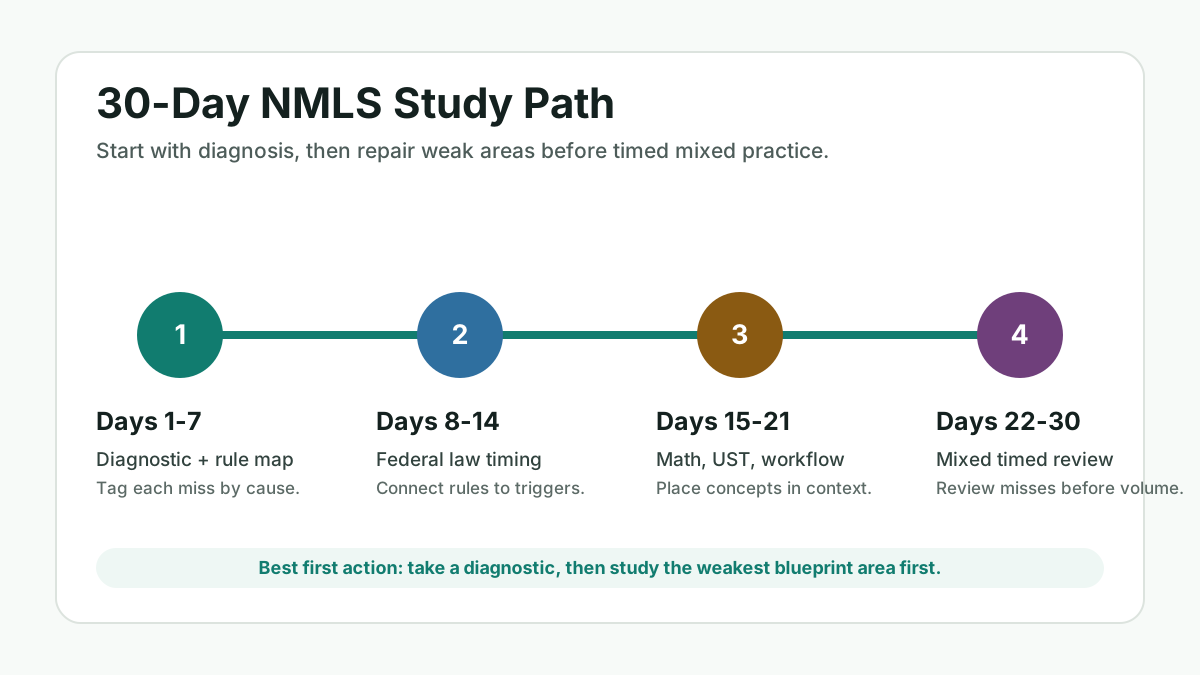
If you have 30 days, do not spend all 30 days reading notes. Use week one to find your weak areas, weeks two and three to repair federal law, math, UST, ethics, and origination gaps, and the final week to prove you can handle mixed, timed questions without repeating the same misses.
A useful 30-day NMLS plan is not a calendar of chapters. It is a repair plan. Most candidates do not fail because they never saw the material; they lose points because they recognize a term but choose the wrong rule, miss a timing trigger, or trust an answer that sounds professional but is not the safest compliant action.
Use this plan as a study framework, not as official testing guidance. Always confirm current exam rules, scheduling details, waiting periods, and licensing requirements with NMLS and your state regulator.
Decision guide
| Situation | Best move | Why it matters |
|---|---|---|
| You just finished the 20-hour course | Take a diagnostic before choosing what to reread | Many candidates feel familiar with the course but discover that scenario questions expose a different weakness. |
| You miss disclosure timing questions | Turn each timing rule into a borrower scenario | The exam rarely asks timing as a clean definition; it usually hides the trigger inside a loan event. |
| Your score changes a lot between practice sets | Pause full sets and inspect the miss pattern | Big score swings usually mean you are recognizing some topics by memory but not applying the rule consistently. |
Days 1-7: Build the rule map before heavy testing
Start by reading the current SAFE MLO content outline and sorting your notes into the five major blueprint areas: federal mortgage-related laws, Uniform State Content, general mortgage knowledge, mortgage loan origination activities, and ethics.
Your first-week goal is not to feel productive by doing hundreds of questions. It is to make the exam less blurry. When a question mentions an advertisement, an application, a changed fee, a referral, a credit decision, or a state license status issue, you should know which bucket you are in before looking at the answer choices.
Take one short diagnostic set near the beginning of the week. Mark every miss as content gap, wording trap, math setup error, timing confusion, or scenario judgment. That tag matters more than the score because it tells you what kind of repair to do.
Days 8-14: Drill federal laws and disclosure timing
The second week should be heavy on RESPA, TILA, TRID, ECOA, HMDA, SAFE Act concepts, privacy, advertising, and prohibited conduct. Do not study the laws as isolated vocabulary only.
For each law, write three lines: what the rule protects, what action triggers it, and what answer choice would be tempting but wrong. For example, if a question is really about a credit decision, an answer about general fairness may sound good but miss the specific ECOA-type duty being tested.
If disclosure timing questions feel confusing, keep a separate timing sheet for Loan Estimate, Closing Disclosure, changed circumstance, rescission, servicing, and adverse action concepts. Do not just memorize numbers; connect each timing rule to the event that starts the clock.
Days 15-21: Add mortgage math, origination, and UST
This is the week to mix calculations with borrower-facing workflow. Practice LTV, CLTV, DTI, discount points, PITI, escrow, cash-to-close vocabulary, and product terms in short blocks.
Uniform State Content should be studied as regulator authority and MLO conduct: licensing, sponsorship, renewal, recordkeeping, supervision, discipline, and prohibited activity.
For origination activities, trace a loan file from first conversation through application, documentation, disclosures, rate lock, approval, closing, and post-closing questions. Many exam misses happen because the candidate knows the term but cannot place it in the loan timeline.
Days 22-30: Shift to mixed timed practice and review
In the final stretch, avoid re-reading everything from scratch. Use mixed timed practice to expose weak areas, then review misses deeply.
For every wrong answer, write the tested rule, the phrase that misled you, and the reason the correct answer is narrower or more compliant. If you cannot explain why your chosen answer failed, you have not finished reviewing that question.
The last two days should be lighter. Revisit saved explanations, flashcards, and high-confidence misses. Do not overload yourself with brand-new material right before test day.
Common mistakes to avoid
- Counting questions completed instead of reviewing why answers were wrong: For each miss, write the rule being tested and the phrase in the stem that changed the answer.
- Studying federal laws as definitions only: For each law, know the trigger, the required action, and the answer choice that sounds reasonable but belongs to a different rule.
- Saving mortgage math until the final week: Add short math blocks by week three so formula choice becomes automatic.
Study checklist
- Take one diagnostic set before building the calendar.
- Keep one-page sheets for federal laws, timing rules, math formulas, and UST duties.
- Review every miss before taking another full mixed set.
- Practice explaining why the second-best answer is wrong.
- Leave the final 48 hours for light review and sleep.
Related practice topics
Is 30 days enough to study for the NMLS SAFE MLO exam?
Thirty days can be enough for some candidates if they already finished required education and can study consistently. Candidates starting from zero or balancing heavy work hours may need a longer runway.
How many practice questions should I do in a 30-day NMLS plan?
Quality matters more than raw volume. A useful target is steady mixed practice plus deep review of every miss, especially questions involving federal law, timing, mortgage math, UST, and ethics.
Next action
Take a 25-question diagnostic first. Do not judge only the score; tag each miss as a content gap, wording trap, timing issue, math setup error, or confidence miss.
Sources used to verify this page
SafeMLO Coach is an independent study aid. It is not NMLS, CSBS, Prometric, a state regulator, a lender, a school, or a law firm. Always confirm licensing, renewal, testing, fees, waiting periods, and continuing education requirements with official sources.
- CFPB: TILA-RESPA Integrated Disclosures (TRID) - CFPB resources for Loan Estimate, Closing Disclosure, disclosure timing, and TRID rules.
- CFPB: Secure and Fair Enforcement for Mortgage Licensing Act (SAFE Act) - CFPB SAFE Act resources for mortgage licensing and registration concepts.
- CFPB: Rules Governing Loan Origination Practices - CFPB resources for loan originator compensation and origination practice rules.
- CFPB: Equal Credit Opportunity Act (Regulation B) - Interactive Regulation B text and official interpretations for ECOA topics.
- CFPB: Your Home Loan Toolkit - Consumer-facing CFPB guide for mortgage shopping, costs, and borrower decisions.
Editorial notes and trust
SafeMLO Coach is an independent study aid. It is not NMLS, CSBS, Prometric, a state regulator, a lender, a school, or a law firm. Always confirm licensing, renewal, testing, fees, waiting periods, and continuing education requirements with official sources.